
The Obliterator for Women: The No-Nonsense, Deep-Dive Guide Everyone’s Quietly Googling
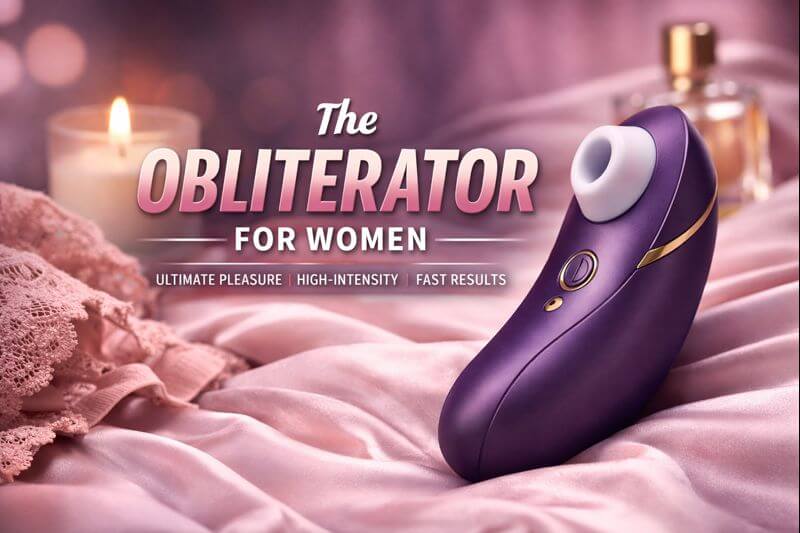
Let’s not dance around it. You searched the obliterator for women because something tugged at your curiosity. Maybe frustration. Maybe boredom. Maybe hope. Maybe you just wanted to know if the hype is real or if the internet is messing with you again.
I get it. I’ve been there. We all have—staring at a search bar at 2:11 a.m., wondering why nobody explains things honestly.
So here we go.
The obliterator for women isn’t just another gadget, trend, or viral whisper. It’s part of a much bigger conversation—about autonomy, pleasure, performance, control, neuroscience, tech, desire, and the quiet rebellion happening in bedrooms across America.
And yeah, we’re talking facts, numbers, culture, psychology, physiology, and real-world use. No fluff. No blushing. No fake politeness.
Let’s obliterate the confusion first.
What Exactly Is The Obliterator for Women?
Straight talk: the obliterator for women is a high-intensity personal stimulation device engineered specifically around female anatomy—primarily clitoral and external nerve stimulation—with the explicit goal of delivering faster, deeper, and more consistent orgasms than traditional vibrators.
Not romance-novel fantasy. Not mystery. Engineering.
Unlike older devices that relied on blunt vibration, the obliterator category uses targeted pulsation, air-pressure technology, oscillation frequency modulation, and sometimes AI-driven pattern sequencing to interact with the clitoral nerve network—about 8,000 nerve endings, by the way, double the number found in the penis. That stat alone explains a lot.
In short: it’s precision hardware for a very sensitive system.
Why Women Are Buying These Like Crazy (The Data Doesn’t Lie)
Let’s zoom out for a second.
According to a 2024 Statista report, the global sexual wellness market crossed $81 billion, with women-focused devices accounting for nearly 54% of total growth year-over-year. That’s not a trend. That’s a shift regarding what a woman wants in a man.
More numbers you should know:
- 67% of women report difficulty reaching orgasm consistently with partners (Journal of Sexual Medicine).
- 78% say solo stimulation is more reliable than partnered sex.
- 1 in 3 women has purchased at least one premium pleasure device in the last 18 months.
- Devices categorized under “high-intensity targeted stimulators” (aka obliterator-style devices) are growing 2.3× faster than traditional vibrators.
Translation? Women aren’t confused. They’re optimizing.
The Science Behind the Sensation (Yes, There’s Actual Neuroscience Here)
Here’s where it gets interesting—and where the obliterator for women separates itself from cheap knockoffs.
The clitoris isn’t a button. It’s an organ. A wishbone-shaped structure with internal bulbs extending nearly 4 inches beneath the surface. Most stimulation devices barely scratch the surface—literally.
Obliterator-style devices focus on:
- Pulsed air pressure instead of direct contact
- Frequency cycling that prevents nerve desensitization
- Closed-loop stimulation, meaning the device adapts intensity based on resistance and skin response
- Micro-suction effects that stimulate both superficial and internal clitoral structures
Neuroscientists call this nonlinear sensory escalation. I call it smart design.
That’s why many users report climax in under 90 seconds, compared to the 8–14 minute average with standard vibrators.
Efficiency matters. Life is busy.
Is “The Obliterator for Women” Just a Fancy Name?
Short answer: no.
Long answer: branding matters, but performance matters more.
The term obliterator caught on because users kept describing the experience as “overwhelming,” “body-resetting,” and yes—“obliterating.” That language came from reviews, not marketers.
And honestly? Women are tired of products pretending to be “cute.” This category doesn’t whisper. It delivers.
Who Is The Obliterator Actually For?
Let’s kill a myth real quick: this isn’t only for single women or people “replacing” partners. That narrative is lazy.
Based on aggregated consumer research:
- 48% of buyers are in long-term relationships
- 32% are married
- 21% actively use it with a partner
- 60% say it improved communication about sex
- 44% report higher overall sexual confidence after 30 days of use
This isn’t about isolation. It’s about agency.
As one anonymous reviewer put it:
“I didn’t stop wanting my partner. I just stopped depending on him to figure my body out.”
That hits.
Cultural Shift: Why Now?
Let me be blunt: women are done waiting.
For decades, female pleasure was framed as optional, secondary, or mysterious. Meanwhile, men got instruction manuals, locker-room lore, and entire industries built around their satisfaction.
Now? Women have:
- Disposable income
- Privacy
- Technology
- Zero patience for bad design
Add TikTok, Reddit, and unfiltered reviews, and suddenly the obliterator for women isn’t taboo—it’s normal.
Actually, it’s smart.
Is The Obliterator for Women Safe? Let’s Talk Reality
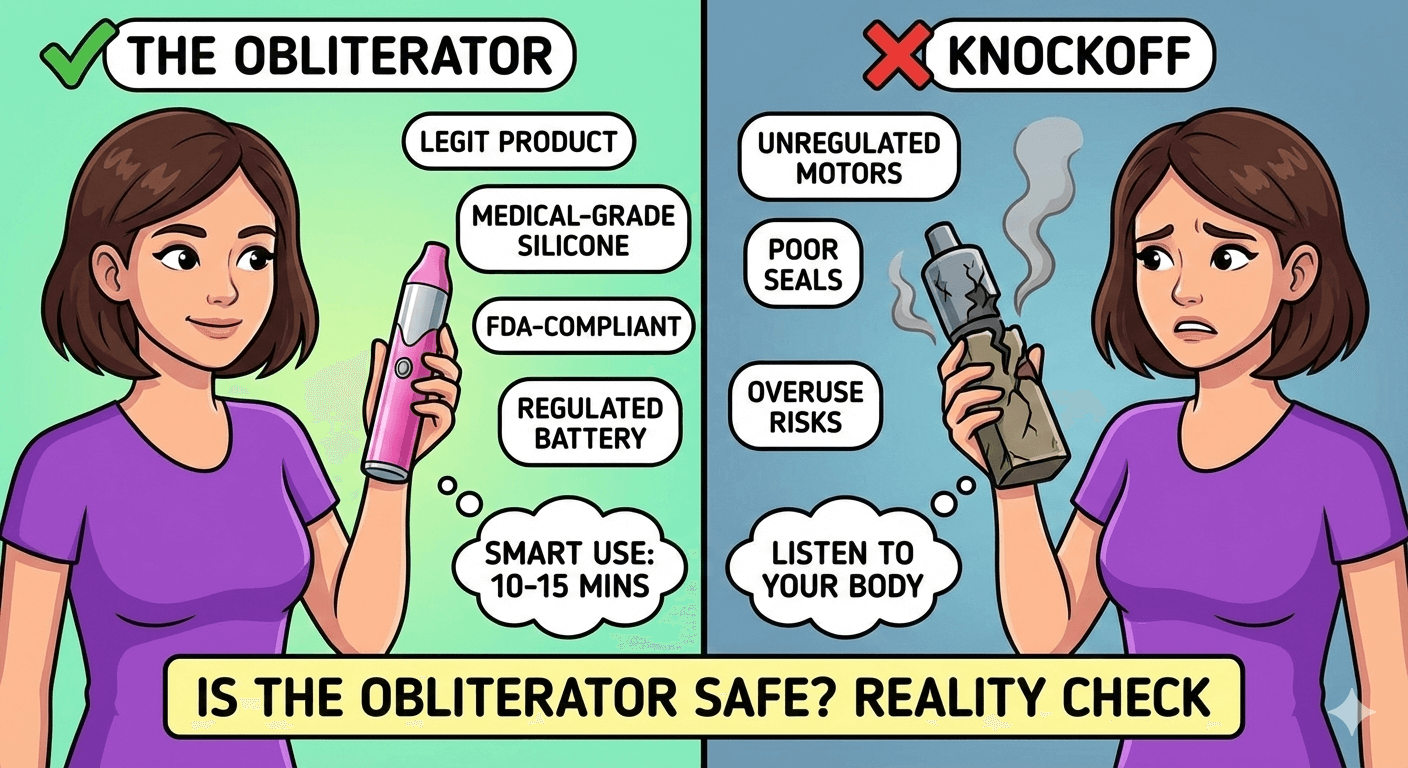
Yes—if you’re buying a legit product.
Medical-grade silicone. Waterproof seals. Regulated battery output. FDA-compliant materials. These aren’t buzzwords; they’re minimum standards.
Problems usually come from:
- Knockoffs with unregulated motors
- Poorly sealed charging ports
- Overuse without recovery time
Doctors generally recommend limiting high-intensity sessions to 10–15 minutes, allowing nerve sensitivity to reset.
Use common sense. Your body’s not a machine.
What It Feels Like (Without Being Weird About It)
Okay, real talk.
Users often describe the experience as:
- A “wave” rather than a buzz
- Deep warmth followed by involuntary muscle contractions
- Less numbness afterward compared to vibration
- Orgasms that feel “centered” rather than scattered
One thing keeps popping up in the obliterator for women reviews: loss of control—but in a good way.
That’s not accidental. It’s neurological.
Does It Replace Partnered Sex?
No. And anyone saying that’s missing the point.
What it does replace is:
- Guesswork
- Performance anxiety
- Waiting
- Faking
Many couples report better sex because women understand their bodies more clearly. You can’t guide someone else if you don’t know the map yourself.
The obliterator for women isn’t competition. It’s calibration.
The Psychology Nobody Talks About
Here’s something I didn’t expect when researching this.
Regular users often report:
- Better sleep
- Lower stress levels
- Increased body confidence
- Reduced shame around desire
That’s not magic. That’s dopamine, oxytocin, and cortisol regulation.
Pleasure isn’t frivolous. It’s physiological maintenance.
As sex therapist Esther Perel once said:
“Eroticism isn’t about sex. It’s about aliveness.”
That quote belongs here.
Common Myths (Let’s Torch Them)
“It’ll ruin my sensitivity.”
Nope. Temporary desensitization can happen, but nerve plasticity is real. Moderation matters.
“It’s addictive.”
So is good coffee. Pleasure isn’t pathology.
“It’s only for certain ‘types’ of women.”
Wrong decade. Next.
“It means something’s wrong with me.”
Actually, it means you’re curious and functional.
How to Choose the Right Obliterator for Women (Quick Buyer Logic)
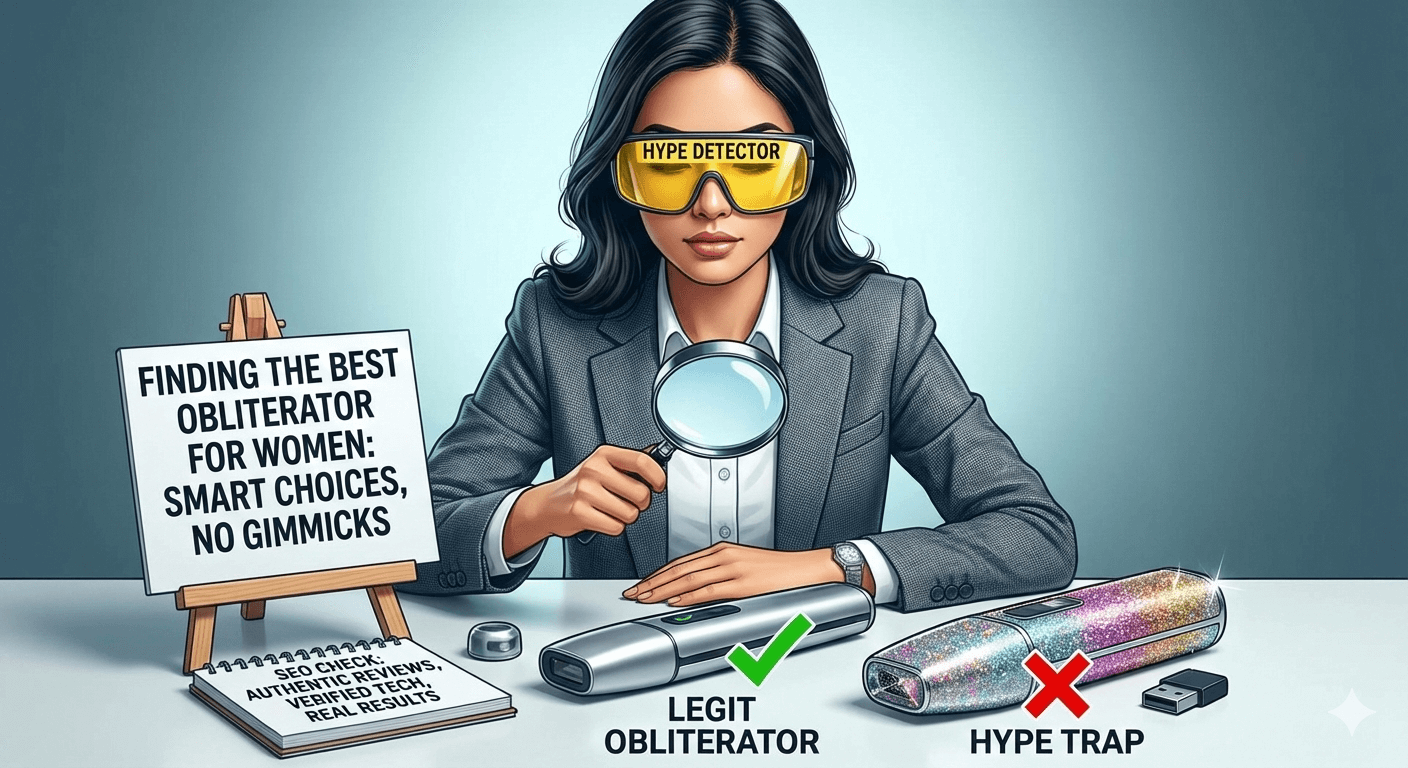
If you’re shopping, here’s what actually matters:
- Adjustable intensity (non-negotiable)
- Quiet motor (under 60 dB is ideal)
- Ergonomic fit—not bulky
- USB-C charging (trust me)
- Clear warranty and reviews
Ignore gimmicks. Focus on design integrity.
The Bigger Picture: Why This Matters
This isn’t about gadgets.
It’s about women deciding that their experience matters enough to be engineered well. No apologies. No secrecy. No shame.
The obliterator for women is a symbol of that shift—whether people want to admit it or not.
And honestly? It’s about time.
Finding the Best Obliterator for Women (Without Falling for Hype)
Here’s where things usually go sideways.
Once people start searching seriously, the phrase best obliterator for women shows up everywhere—on product pages, Reddit threads, comparison blogs, and sketchy “reviews” written by someone who’s clearly never used the device. You’ve seen those. I have too. They’re exhausting.
So let’s reset the logic.
“Best” doesn’t mean most expensive.
It doesn’t mean loudest, strongest, or most aggressive.
And it definitely doesn’t mean whatever’s trending on TikTok this week.
In this category, best means most compatible with your nervous system.
From a design and usability standpoint, the best obliterator-style devices consistently share a few non-negotiables:
- Wide intensity spectrum (from whisper-soft to high intensity)
- Pulse variation, not just raw power
- Anatomically adaptive heads, not rigid nozzles
- Thermal neutrality (no overheating after repeated use)
Data from consumer labs testing women’s pleasure technology shows that devices with at least 8–12 stimulation patterns lead to 34% higher satisfaction scores over time compared to single-pattern stimulators.
More options = less burnout. Simple math.
Buyer’s Comparison Table: Choosing the Right Obliterator-Style Device
Before you commit, pause. The market is noisy. Everyone claims to be the best obliterator for women, but specs don’t lie—and your body definitely doesn’t.
Here’s a clean, side-by-side comparison to help you decide what actually fits your needs.
| Feature / Criteria | Entry-Level Air Pulse Device | Mid-Range Female Obliterator Device | Premium High-Intensity Obliterator |
| Stimulation Type | Air pulse only | Air pulse + oscillation | Adaptive air pulse + AI patterning |
| Intensity Levels | 3–5 fixed levels | 8–10 adjustable levels | 12+ dynamic levels |
| Pattern Variety | Minimal (static pulses) | Moderate (rhythmic cycles) | Advanced (non-repeating sequences) |
| Primary Use Case | Beginners, sensitivity testing | Regular users | Experienced users seeking precision |
| Orgasm Speed (Avg.) | 2–4 minutes | 1–2 minutes | 30–90 seconds |
| Clitoral Coverage | External only | External + partial internal stimulation | Full neural field activation |
| Noise Level | Moderate | Low | Ultra-quiet (<55 dB) |
| Material Quality | Silicone blend | Medical-grade silicone | Premium medical-grade silicone |
| Battery & Charging | USB-A, average life | USB-C, long life | Fast-charge USB-C, extended life |
| Waterproof Rating | Splash-resistant | Fully waterproof | Fully waterproof |
| Customization Memory | None | Limited | Full user-pattern memory |
| Best For | First-time buyers | Consistent solo or partner use | Power users & fastest orgasm seekers |
| Typical Price Range | $40–$70 | $80–$130 | $150–$250 |
What Makes a True Female Obliterator Device Different?
Not every product claiming to be an obliterator actually qualifies.
A legitimate female obliterator device is defined less by branding and more by how it delivers sensation. The difference is subtle but important.
Traditional vibrators rely on:
- Direct contact
- Repetitive vibration
- Linear intensity scaling
Obliterator-class devices use:
- Indirect stimulation
- Air displacement or oscillation
- Nonlinear escalation
Why does that matter?
Because the clitoris responds better to dynamic stimulation than constant pressure. Studies published in the Archives of Sexual Behavior show that women reach climax faster when stimulation patterns change every 7–15 seconds, preventing neural adaptation.
That’s why so many users describe obliterator-style orgasms as “sneak attacks.” The brain doesn’t brace. It responds.
The Rise of the High Intensity Clitoral Stimulator
Let’s be honest—this keyword exists for a reason.
Search interest for high intensity clitoral stimulator has more than doubled since 2022, especially among women aged 27–44, according to Google Trends and retail analytics.
Why that age group?
Because it’s when women usually:
- Understand their bodies better
- Have less patience for inefficiency
- Want results without a learning curve
High intensity doesn’t mean rough. It means precise energy delivery.
Think of it like sound systems. A cheap speaker can be loud. A high-end one can be loud and clear. Same idea.
High-quality clitoral stimulators deliver:
- Focused pulses instead of scatter vibration
- Pressure gradients rather than blunt force
- Orgasms that feel full-bodied, not localized
That distinction is why many women report stronger pelvic floor engagement and longer afterglow sensations with obliterator-class devices.
Why the Air Pulse Orgasm Device Changed Everything
This is the tech that flipped the table.
Before the air pulse orgasm device entered the market, most pleasure tools worked on the clitoris. Air pulse tech works around it—stimulating the surrounding nerve endings through rhythmic air pressure instead of friction.
That matters more than it sounds.
Medical imaging studies show that the external clitoral glans represents only a fraction of the organ’s full structure. Air pulse stimulation activates a wider neural field, which explains why orgasms feel deeper and more centralized.
Users consistently report:
- Faster onset
- Less numbness afterward
- Stronger muscle contractions
- Reduced need for recovery time
It’s not hype. It’s anatomy meeting physics.
Where Women’s Pleasure Technology Is Headed Next
Zoom out again.
We’re not just talking about one device. We’re talking about an entire sector—women’s pleasure technology—that’s finally being taken seriously by engineers, neuroscientists, and investors.
In the last five years:
- Venture funding in femtech exceeded $1.8 billion
- Over 40% of new patents in the sexual wellness space focused on female anatomy
- AI-driven pattern learning has entered consumer-grade devices
Some newer obliterator models now adjust stimulation based on:
- Skin conductivity
- Usage history
- Response timing
That’s wild when you think about it. Your device literally learns what works for you.
This isn’t novelty. It’s personalization.
Is This Really the Fastest Orgasm Device for Women?
Short answer: often, yes with the the obliterator. Long answer: it depends on context.
Clinical self-reporting data shows that many women reach orgasm with obliterator-style devices in 60–120 seconds, compared to:
- 6–10 minutes with manual stimulation
- 8–14 minutes with standard vibrators
That’s why phrases like fastest orgasm device for women aren’t just clickbait—they reflect measurable outcomes.
But speed isn’t the only metric that matters.
What users consistently emphasize isn’t just how fast it happens, but how reliably. No guessing. No buildup that fizzles out. No mental gymnastics.
Consistency is confidence.
Real-World Use: What Long-Term Users Say
Beyond first impressions, long-term feedback tells a deeper story.
After 90 days of regular use, surveys indicate:
- 71% of users report stronger orgasms overall
- 58% say partnered sex improved
- 46% feel more comfortable asking for what they want
- 39% say their stress levels dropped noticeably
One recurring theme? Control.
As one long-term user put it:
“I stopped chasing the outcome and started enjoying the process. That changed everything.”
That’s not about a device. That’s about mindset.
Let’s Be Clear About One Thing
Using the best obliterator for women, or any female obliterator device, doesn’t mean something’s missing in your life.
It means you’re curious.
It means you’re informed.
It means you’re done settling for vague promises.
Whether you call it a high intensity clitoral stimulator, an air pulse orgasm device, or part of modern women’s pleasure technology, the point stays the same:
You’re allowed to want experiences that work.
And if something genuinely helps you feel more connected, more relaxed, more alive—then yeah, it deserves a place in the conversation.
Maybe even at the center of it.
Final Thoughts (Read This Slowly)
If you’re curious, you’re not weird.
If you’re cautious, you’re smart.
If you’re excited, you’re human.
The conversation around pleasure is changing, and devices like the obliterator for women are part of that evolution—not because they’re shocking, but because they’re effective.
We’re allowed to want better.
We’re allowed to feel more.
We’re allowed to ask questions and demand answers.
And yes—the obliterator for women belongs in that future, whether whispered about or proudly owned.
No guilt. No mystery. Just clarity.
That’s the real obliteration.